Edible Portraits

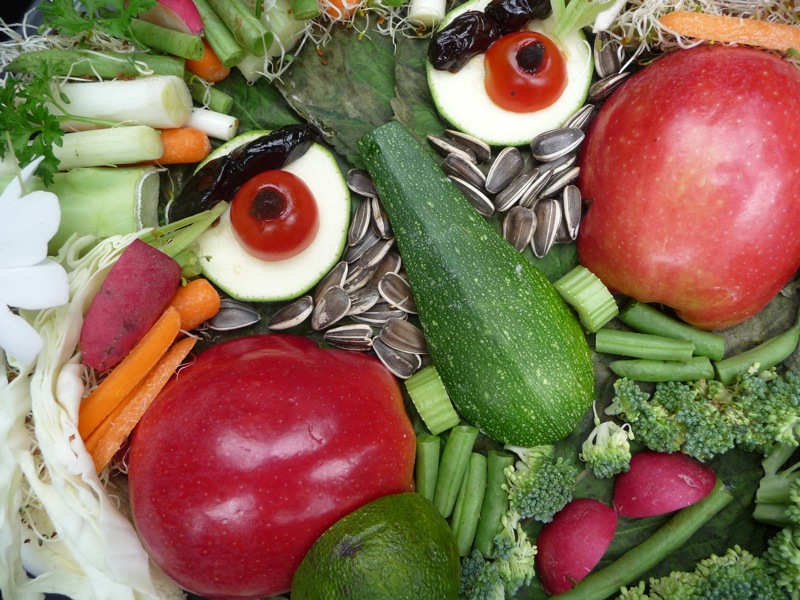
Giuseppe Arcimboldo was a talented 16th century Italian artist whose work included court portraitist, decorator, and costume designer. It was, however, his unique and unusual portraits that he is best known for, where fruits, vegetables, plant material and other unexpected objects were assembled to create human representations. While this might seem out of the ordinary, his greatly admired paintings were made during the Renaissance, a period where lots of unusual explorations in art took place. Needless to say, this project was a hit. Kids loved the idea of making their art and eating it too.

Continue reading

32 Comments

Filed under Art and Nature, Artists, food art, Giuseppe Arcimboldo

Found Object Robots

Using found objects to make art is a great way to stretch your imagination. It involves taking materials designed for one purpose and using them for another. One of the most famous examples is Pablo Picasso’s Bull’s Head,  made from a bicycle saddle and handlebars. It’s such a simple and humorous idea, but someone had to think of it. The challenge here is to make a robot sculpture using only found objects in metal. Let the games begin!

Continue reading

3 Comments

Filed under Pablo Picasso, recycling, sculpture

Stacking Stones

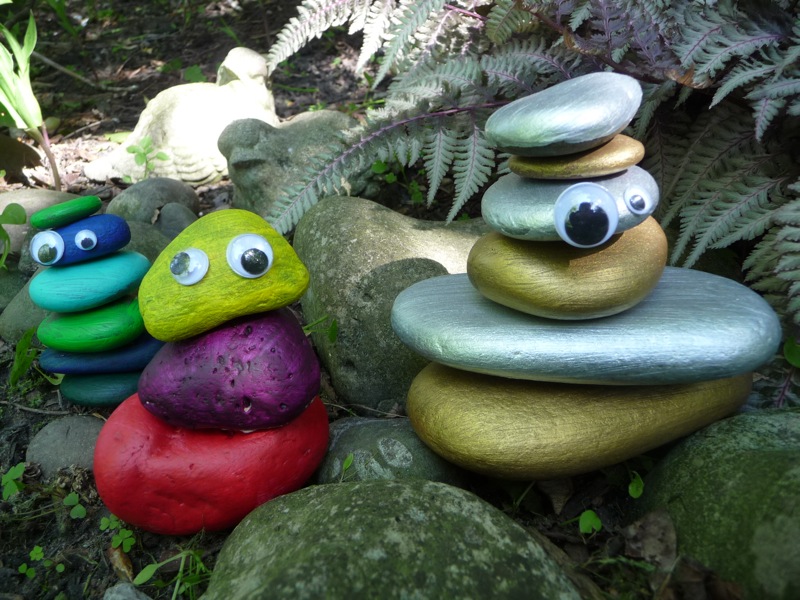
Humans have been stacking stones for an awfully long time. England’s Stonehenge was thought to be used as a burial site, and created as early as 2500BC. Inuksuks, made by the inhabitants of the Arctic region, were used as markers for travel routes and hunting grounds. Cairns have been found in Scandinavia as trail and sea marks, and in Somalia, to indicate tombs of former kings. Modern cairns are commonly used to indicate hiking trails, biking trails, or areas of possible danger. And some very patient people have even transformed rock balancing into performance art. These man-made stacks of stones and delicately balanced sculptures are truly fascinating things of beauty.

Continue reading

4 Comments

Filed under Art and Nature, rock painting, sculpture

Felt Topography

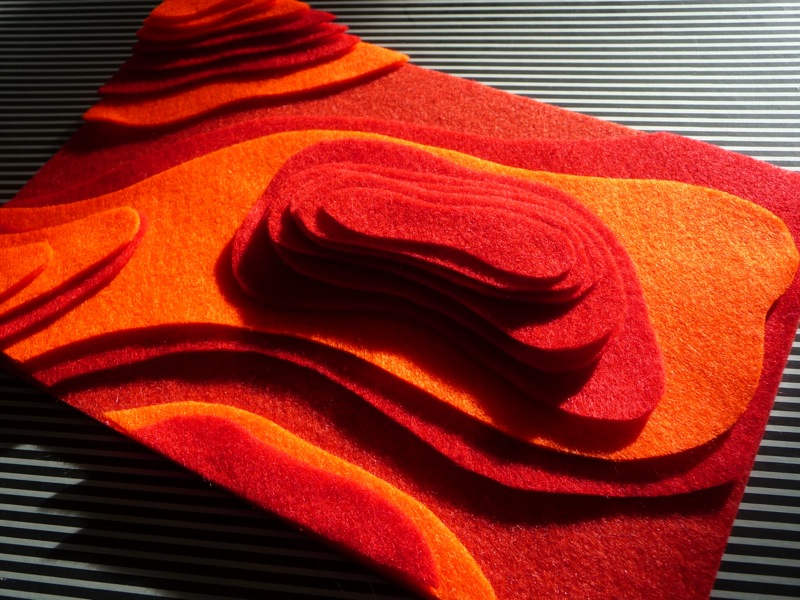
Topographic maps provide us with a bird’s eye view of three dimensional surfaces. With the use of contour lines, shading, and precise measurements, these representations show us how land rises into rock formations, or slopes gently towards a stream. This project is a great accompaniment to lessons on topography, where children can apply their knowledge to create unique looking landscapes using layers of felt.

Continue reading

3 Comments

Filed under felt

Lasting Impressions From The Show Off

OCAD University’s recent 2011 Graduate Exhibition had over 500 thesis projects on display, from 12 different disciplines, spread over 6 floors.  As always, it’s impossible to give everything proper attention, but the children I brought along loved the environment, were inspired by what they saw, and eagerly chatted with some of the artists. But after a few hours of this, your brain tends to get a bit cloudy, which could explain why I almost bought the kids pins with illustrations of serial killers. This is true. I innocently wandered over to look at Lauren Kaiser’s work, but in my distracted state, failed to immediately notice these were illustrations of famous serial killers as children, doing what I suppose future serial killers might do like beheading Ken and tying up teddy. Her humorously disturbing work was definitely not child friendly, so I quietly put the Charlie Manson pin down and engaged in some major distraction. This was clearly my cue to call it a night before I failed miserably at parenting 101. Below are a few of my favs.

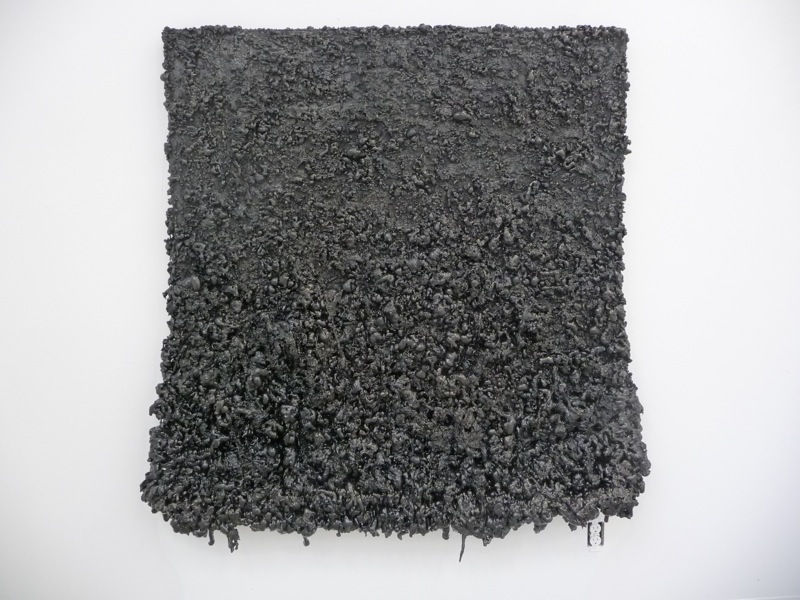
Praxis by Callum Schuster was made with insulation foam, spray paint and enamel. It’s texture and unconventional beauty was truly stunning.

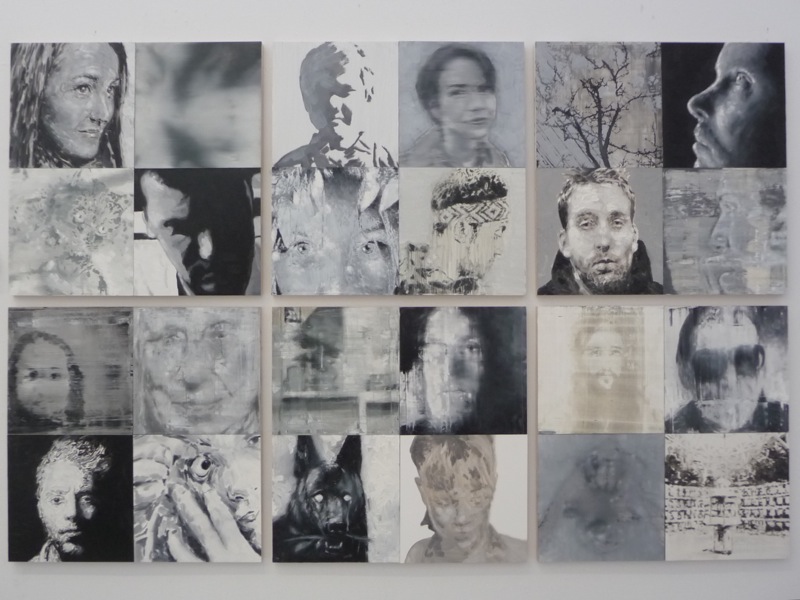
Untitled (Grid #1) by Charles Bierk. I liked the parts, but the whole was much more powerful and intense.

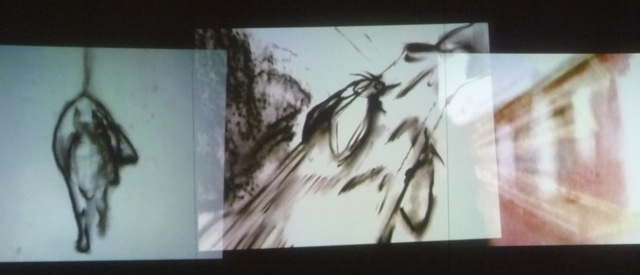
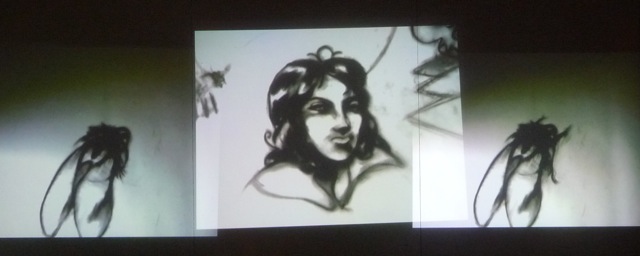
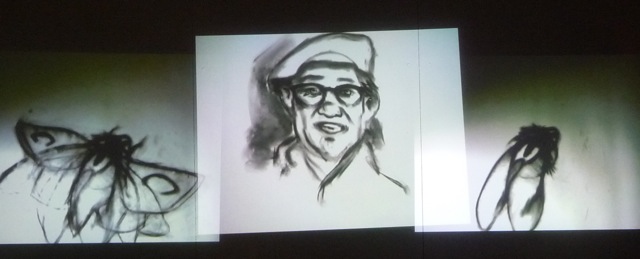
Memorium by Michael McDonnell. This was all about metamorphosis with the use of animation and video. The result was mesmerizing, and the hauntingly beautiful music was the perfect accompaniment.

Leave a comment

Filed under events

Melted Camembert Cheese

Imagine finding inspiration from a soft, overripe, melting Camembert cheese. This is what happened to Salvador Dali, whose inspired moment lead to one of his most famous paintings, The Persistence of Memory. In this painting, hard pocket watches are found unexpectedly limp like melted cheese, and draped in a bizarre dreamlike, coastal landscape. This strange juxtaposition of objects is typical of Surrealism, a 20th century artistic and literary movement which sought to combine the world of dream and fantasy with reality.

Salvador Domingo Felipe Jacinto Dali i Domènech was born on May 11, 1904, in the small town of Figueres, Catalonia, Spain. He was an extremely versatile and talented artist, exploring different styles and media as a painter, sculptor, draughtsman, illustrator, writer and film maker. Dali is probably best remembered for his striking and unusual images in his Surrealist work, as well as his flamboyant personal style, and quite possibly the most famous waxed moustache in the world. Feliç aniversari Dali! Let’s celebrate his birthday by making some melted looking creations of our own.

Continue reading

Leave a comment

Filed under Art Movements, Artists, polymer clay, Salvador Dali, Surrealism

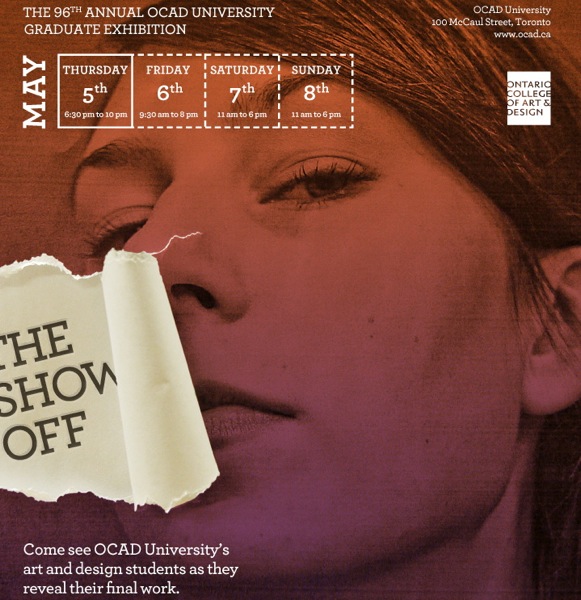
OCAD Grad Show 2011

The Ontario College of Art and Design will be hosting their annual grad show this weekend, showcasing the work of its 2011 graduating students, from both the Faculty of Art and the Faculty of Design. Why not bring your kids and help inspire the next generation of creative thinkers. With work from over 500 students, there’s bound to be something to please everyone. For more information about  “The Show Off”, check out the website.

Leave a comment

Filed under events

Suranimals

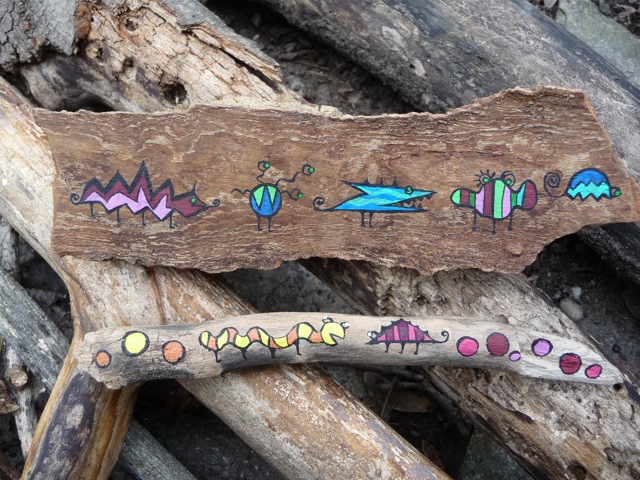
It’s spring, and little creatures are just about everywhere you look, hiding under piles of leaves, and resting under rocks and trees. Insects alone outnumber us, with an estimated 10,000,000,000,000,000,000 (10 quintillion) of them worldwide, making them the most successful life form on the planet. I can’t think of a better way to celebrate than by coming up with a few imaginary ones of our own, inspired by the work of artist Jerome Couëlle .

Couëlle is a french born artist, who lives in both Toronto and Vermont. He uses the word suranimals to describe the wonderfully imaginative creatures that inhabit his surreal paintings. You’ll find fish strolling about on legs, smiling holstein cats, and multi-coloured insects with hats. I invite you to discover his magical world, which will surely inspire you to create some whimsical creatures of your own.

“My paintings are dedicated to the animals whom I call ‘suranimals’ for they are all knowing, to the children, to the artists, to the poets, the writers, the musicians who refuse to be chained to what used to be, and do not accept the world as their reason has taught them, but have freed their eyes to be the true window to peer into infinity.” Jerome Couëlle

Continue reading

Leave a comment

Filed under Art and Nature, Artists, Jerome Couëlle, painting

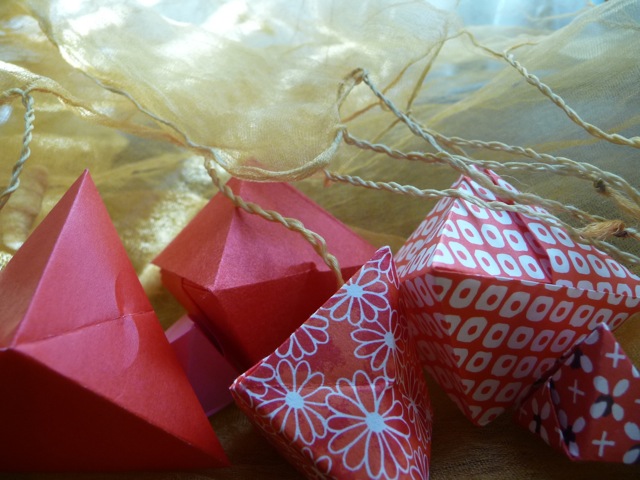
Origami Snap Hexahedron

For those who can’t remember grade 6 math (and we are a rather large group), a hexahedron is a six sided three dimensional geometric figure. The snap part refers to the very cool final step in folding, which brings this lovely shape to life. Now if only it had a chocolate inside.

Continue reading

Leave a comment

Filed under origami, paper crafts

Framed By Klimt

Gustav Klimt was a highly influential Austrian painter and illustrator who was born in 1862, and who died in 1918. He was one of the founders of the Vienna Secession movement, whose members hoped to create a new style of art, breaking with historical influences and tradition.

Klimt explored many themes such as love and the cycle of life, but is best known for his look at sexuality in art, considered highly controversial during the stuffy Victorian era in which many of his works were created. Some of his most beautiful paintings showed women enveloped in luxurious shapes, colours, patterns and costumes. The use of gold also comes to mind when thinking of his sumptuous work. His prominent use of gold leaf was thought to be influenced by his father’s profession as an engraver, as well as Byzantine imagery and the mosaics of Venice seen throughout his travels.

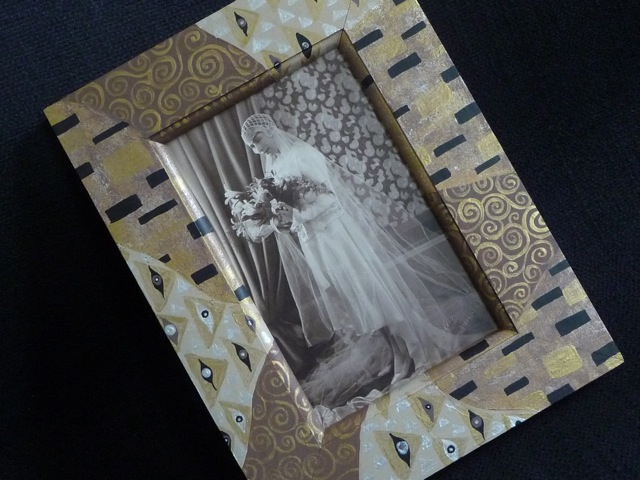
This project focusses on Klimt’s richly patterned works, infused with delicious golden swirls and textures. You’ll be painting a frame, which can then be used to display your own artwork or favorite photo.

Continue reading

Leave a comment

Filed under Gustav Klimt, painting